
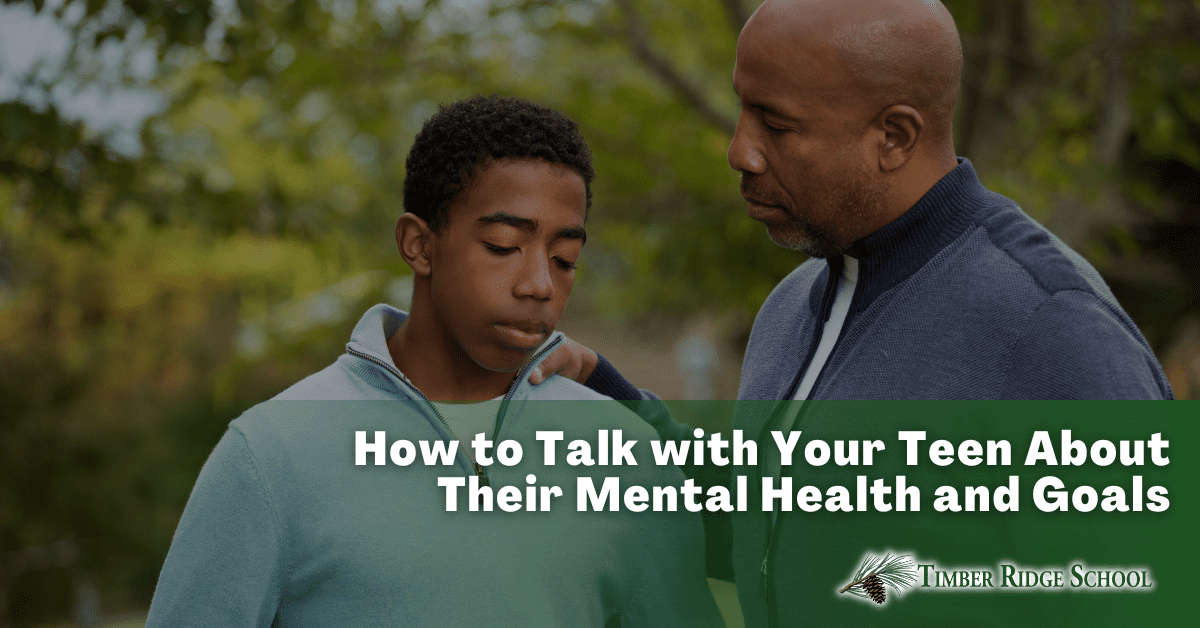
Notice something “off” with your teenager lately? Talking to your teen about mental health struggles (depression, anxiety, etc.) isn’t always the easiest conversation to have, but it can be critical to create a healthy dialogue and provide the resources and support that your teen may need. Adolescence is a time of rapid change, and teens often feel pressure to keep struggles to themselves.
At Timber Ridge School, we help equip struggling adolescent boys with tools to improve their mental health. Healthy discussions with trusted and licensed therapists are a huge part of the recovery method that we utilize. In fact, treatment goals are often developed based on identified needs by the students’ parents and the students themselves.
It’s important to remember: Just because your teen isn’t directly asking you for help, doesn’t mean that they aren’t struggling silently.
Below are practical, compassionate strategies to help you connect with your teen about their emotional well-being and their goals.
Normalize the Conversation
Is your teen clamming up? It’s important to understand that this is normal. Few teens may be open to talking to their parents about their mental wellbeing at first. It may take time and effort to convince your teenager that it’s a conversation worth having.
Tips:
-
Establish a Safe Environment
Have a “no conversation is out of bounds” agreement with your teen. Establish trust and understanding that a conversation with you is always going to be a safe environment. And that might take some self-discipline to listen, ask questions, and not overreact to what issues they trust you with.
-
Be Consistent
Make conversations about mental health a regular thing. Over time, consistency in approaching them and encouraging them to open up will win out. According to Healthline, habits can form in as little as two months of dedicated time. By normalizing the conversation, making it a part of your parenting routine and a scheduled checkup just like you might do for grades or athletics, your teen will begin to see the conversation as a normal part of daily life.
There is another piece to normalizing communication about mental health: don’t be afraid to talk about your own struggles and life experiences. Even if teens don’t want to admit it, they are typically looking to their parents and other adult authority figures for cues on normal social behaviors. If they hear firsthand the ways you have struggled with and overcome mental health issues in your own life, it motivates them to try similar solutions and keep communication lines open.
Lead with Curiosity, Not Concern
Don’t approach the conversation from a place of combativeness, haughtiness, or overt concern. You can start by simply asking questions about how they’re doing and seeing how they respond.
“How are things going lately?” “Is there something on your mind you want to talk about?”
You may need to practice tailoring your follow-up questions to their specific situation.
Are they struggling with something in particular? Are they willing to talk about that thing or do they have a defensive shield up? How are their friendships impacting their struggle? Social media, their relationship with school, etc.?
There isn’t going to be a one size fits all conversation model that you should follow. Your teenager is a unique individual with their own private thoughts and experiences, and how you address what they’re telling you should be highly tailored to their own specific issues.
And as Psych Central points out here, your personality actually isn’t static – it changes with age. Your teenager is still figuring themselves out. Through your conversations, maybe they’ll adopt new strategies for how they can react to their struggles as they grow and learn.
Prioritize Listening Over Talking
While this may seem like an obvious one, listen more than you speak.
It’s a classic teenage gripe – it seems like no one ever listens: Adults are just there to make rules and get in the way. We’ve all heard it before, and maybe we even felt that way when we were younger. It’ll go a long way if you prioritize listening in these conversations with your teen. They will feel safe, heard, and understood.
Listening strategies could include:
- Reflecting back what they’ve said (“So it sounds like…”)
- Asking follow-up questions gently
- Avoiding defensive reactions or rushing to fix things
When it is your time to speak, ask follow-up questions as discussed above. Try to drill down on what they’re telling you and why they feel the way they do. Offer advice that is unique to their situation so that they know you’re listening and comprehending their struggles.
And sometimes, it’s okay to not say anything at all. “I don’t know,” or “I don’t have all the answers, but I’m here for you during this difficult time and I hope you know you can continue talking to me for all of it” can go a long way. Teenagers have no problem recognizing authenticity, and will respect you for not making up things as you go. Not knowing is a part of life; not trying shouldn’t be.
Boston University published a convenient guide on active listening that you may find useful for learning new techniques. Paraphrasing, clarifying, reflecting, summarizing, and more are all learned techniques that can help your teenager feel more understood and connected to you on a deeper level. Practice, and use them in other conversations as well. Everyone appreciates when you truly listen to and engage with what they have to say.
Distinguish Between Goals and Pressure
It is good to have goals in all areas of life. But sometimes for kids, it feels like there are too many goals and that to achieve all of them would require superhuman ability: get good grades, succeed at sports, make friends, be mentally healthy.
Anxiety surrounding goal-setting can be exacerbated by social media, and teens seeing friends with seemingly “perfect lives” that are digitally manicured to present a certain appearance.
A helpful reframing could be:
“Goals aren’t obligations you must achieve perfectly — they’re opportunities for meaningful growth.”
It may be helpful to reframe goals away from pressure. A goal for your teenager shouldn’t be something they have to achieve, at least not perfectly, but merely something to strive for in the name of self improvement. Help them see that the process is the point: it’s okay to not do everything you set out to do in life, but you should try as hard as possible to make it happen.
Mental health can skyrocket when you have a focus on outside of anxiety or struggle. When you are fighting every day to be the best version of yourself, that can include prioritizing wellbeing and self care. Talk to your teen about how setting a goal to be better is a holistic package: it involves physical, emotional, mental, and spiritual health in equal measure. You can’t ignore one area and hope that another makes up for it.
Consider Getting Outside Support
There is no harm in introducing a professional into the equation if the situation calls for it. Some mental health topics, or areas of struggle, might be “outside your pay grade,” so to speak.
Some serious mental health conditions, like clinical depression, require professional help to treat correctly. While you won’t do any damage having conversations with your teen about what’s bothering them, sometimes professional assistance is required to take the response to the next level.
If you think your child has a diagnosable condition that is causing them to struggle, don’t hesitate to seek outside support. Most people go to the doctor when they feel physically unwell; why should we treat mental health any different?
In Conclusion
Here at Timber Ridge School, the mental health and wellbeing of our students is our utmost daily concern. While we prioritize their grades, athletics, and interpersonal relational growth, none of those things matter if they are struggling on the inside.
Checking in on mental health always starts with a simple conversation. Hopefully, some of the tools and tips that we’ve learned over the years will come in handy when speaking with your own teenage children. Some days it will seem difficult, or pointless, or too intrusive, and that’s okay. Just don’t stop communicating with your kids and listening to what they have to say.